
Blog #4: Riding The Wave Of Grief & Enhancing Your Emotional Power
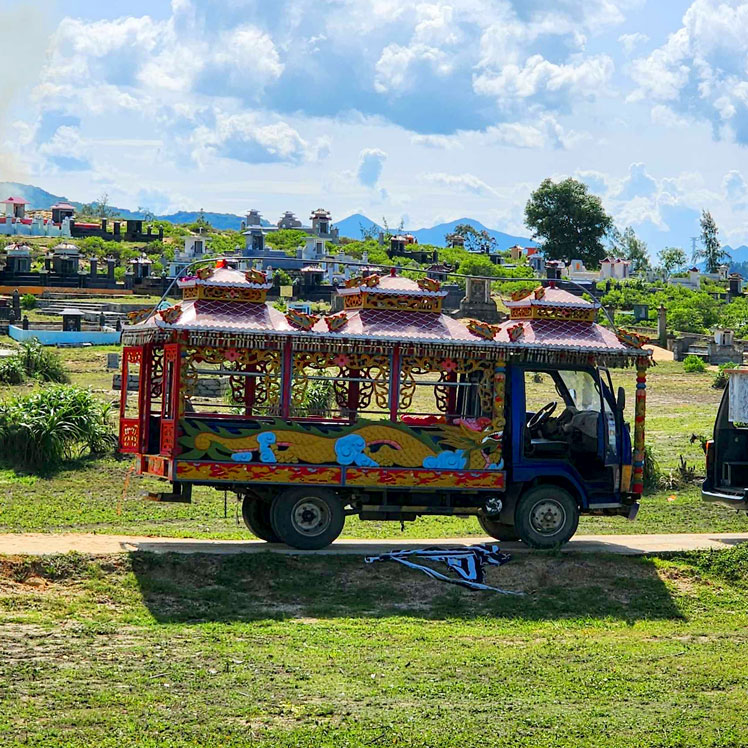
Last night a bout of sadness hit me while I was hanging out with friends. Grief is like that, I never know. I’m never prepared. It can come as abruptly as death. It lingered through my sleep, disturbing me through the night with various thoughts and dreams poking the silence meant for peaceful rest. I woke up feeling groggy and tired. How do you think I handled it? What would you do? What is the right course of action in the presence of sadness? I’ll share with you what I decided to do and what the grief cycle brought about. But first, allow me to tell you a story.
My middle sister, who chose to stay behind in Viet Nam when she was 16 years old the night our family escaped, passed away recently at the age of 60, making five complete rotations around the Chinese 12-sign Zodiac. She chose the sweetness of first love over the security of family. I was estranged from her for over 30 years until my mom chose to make a trip back despite her feeble condition and was subsequently hospitalized shortly after her arrival.
I chose to come back with my brother to visit our mom. She passed away not too long after. Though barely able to walk from the kitchen to her bedroom without the aid of the wall in my oldest sister’s Louisiana home where she lived, my mom chose to take the risk of the trip to tend to some details that were unsettled in her heart. She survived the incredibly more dangerous journey of our escape 31 years prior, but time and life prevented her from pulling through this safer and more luxurious return trip at the age of 78. Before she left for her trip, she said to me, “If I die in Viet Nam, you have to come to my funeral.” I teasingly said, “Mom, if you live, I’ll come visit you. If you die, who will I visit?” She’d complained off and on that I was still the only child who had not made the trek “home.”
Being present for her death and funeral in 2011 was one of the peak healing experiences of my life. It reconnected me with a culture I’d sealed away, and with time, revealed to me the traumas of my childhood. Our relatives from near and far came and stayed, some of whom could barely afford the bus fare. My sister’s friends and neighbors came. They all stepped up to tend to the details of shopping, cooking, cleaning, tending to each other and whatever else came up. The floor that was the kitchen meal prep by day became the resting spot at night – no need for a mattress or even a blanket. The men who sat outside visiting would often stay awake through the night to guard – a vigil to make sure there was always lit incense on her altar and to be present to the deceased. When tired, they would just fall asleep right in the chair or lie down on the tiled floor of the porch. We didn’t have to worry about matching sheets and pillows or clean towels. They didn’t require much. They just wanted to be present. Thus, we were left to make some important funeral decisions and to grieve. And it was a special kind of grieving – not one done in isolation but experienced right in the midst of the fullness of life – tears, conversations, laughter, frustrations, aromatic spices, eating, drinking, and community. There was a reverent solemnity as well as a busy buzzing that was sometimes aggravating (to my Western sentiment) but that was oftentimes natural and comforting.
We kept our mom in an iced glass coffin for about a week right in the middle of my sister’s living room as we waited for my other siblings to arrive. She looked like Snow White, peacefully sleeping. Anyone could visit and chat with her anytime they wanted, no visitation schedule to adhere to. Her grand and great grandchildren would play cards right on the floor by her coffin. I would walk by from time to time to talk to her, to sing to her. Each day, we chanted to her. Even my dad, who had Alzheimer, would stand by her coffin, sometimes with tears in his eyes. I don’t know whether he recognized her or was conscious of what was happening, but his heart knew.
My sister’s home of seven became a hostel sheltering about 30. We were each in our own state and we didn’t need to fix each other. I really appreciated their ability to accept things and to just be with what is. This capacity to accept things – which I had rejected as weakness – became a solace during those days of grief that continued to hold me tenderly for the days and months to come. The image of a particular relative was etched in my mind. A short, heavily tan-skinned malnourished looking woman with dark, penetrating eyes would often just sit on a wooden platform by the door leading to the kitchen, quietly watching life and its many forms unfold in front of her. Yet, when there were things to be done, she worked diligently at her tasks. She didn’t say much. She was just there quietly working or sitting. I watched her as she sat watching – no resistance or agitation for life’s busy demands or its seeming uneventful boredom. Later, I came to realize she was my first teacher on the embodiment of wu-wei, Lao Tzu’s teaching of doing-nondoing.
When I started capturing some of these thoughts, I was sitting in a hotel bed with my laptop propped on my thigh during the siesta hour in the midst of attending my sister’s funeral services (which goes past the actual burial). My niece – her daughter – was sleeping next to me. As I wrote, I could see clearly that my spiritual path, which “officially” started in early 1999, was more about stress management, expanding perspectives and increasing my capacity to handle life – the management of the unhealed symptoms of trauma as they surfaced. With time, I was led to begin the journey of healing my traumas at its roots. That growth odyssey expanded and deepened with the pivotal return trip in 2011. If you’re interested in hearing those stories of healing – what the traumas were, how they came up, and what I did to resolve them, let me know with a comment below.
I shared in my The Foundation of Yoga book that there are two primary wholesome outcomes of the yogic path – life mastery and liberation. Life mastery is the enhancement of skills to better manage life, a valuable gift to gain more peace and happiness. Liberation occurs when the conditions for peace and happiness are no longer present because the roots of suffering have been healed. There is no lack to manage; no unworthiness to prove. This is the peace that surpasses all understanding, or the state of equanimity attained from seeing the wisdom of cause and effect. I am not fully free of conditions. And I am immensely grateful to have experienced enough healing to share with friends, “I don’t need to be anywhere, and I can go wherever. I don’t need to do anything, and I can do whatever is needed.” That’s not to say I don’t struggle with the process sometimes because I still do. And with the deaths of a nephew and a sister months apart (and before this writing was finalized and shared, the death of an uncle), this year has provided many opportunities for surrendering into the often difficult, deep and ultimately healing internal dive that is both enriching and freeing. I heard recently, “The edge of our expansion begins at the beginning of those feelings we’re always so desperate to avoid.” (Dr. Julia DiGangi)
Last June, with a carry-on, a backpack and a week’s reservation for a condo in Da Nang, I relocated to Viet Nam. I’ve received many blessings here, one of which was the chance to have seen my sister more in the last 16 months than I did the previous 43 years. We were just beginning to bridge the gap of our 4-decade estrangement. I am grateful for those shared moments and the chance to visit her a few days before her death. At her funeral, I had the opportunity to say good-bye and wish her a happy continuation as her casket sat propped by beams above a hole that would be the final resting place for her body.
I’ve been speaking here of choices, the choices of 3 women whose lives have been interconnected. Thus, our decisions have affected each other. I’m also aware that “choice” is a way of communication. I’ve come to realize that the so-called choices and outcomes of my life and those I love have a much deeper origin. This is not a topic to be discussed here. What can be said is that the totality of my life is the result of the past and present micro moment opportunities that show up and how I relate to them – what I am willing to let in, accept, heal and grow from.
Thus, this morning, I could have chosen the path of life mastery. I could have set my sadness aside, showered, and continued with my day. If motivation was needed, I could certainly produce positive thoughts, find things to be grateful for, give myself a pep talk, or simply rest in my breath as I did what needed to be done. I would certainly have been involved in my activities and enjoyed my day. And sometimes, that’s exactly what I need to do because the details of my life require it.
I now have more flexibility, so I chose to message my friend, canceling my morning plans. I settled back into bed, laid there feeling the sadness and fell asleep for another two and half hours. I spent the day in bed, relaxing as I continued to witness my mind, body and emotions. The emotional energy of sadness hummed in the background, and it was OK. I knew that being with grief could be the portal for something deeper to surface. At about 1:30, I brought my lunch to the rooftop. It had been raining on and off, so the weather was cool, and the breeze was refreshing.
Two bites in and the tears started. I put the bowl aside and sat. A few minutes later, the anger and frustrations voiced themselves. I picked up my phone and let my fingers vent the emotions flooding forth. I whined and complained. I listed my grievances. Two short paragraphs later, I saw my opportunity. I was still struggling with surrender, with trust, with how things were showing up on my journey. I was still conditional with myself. The seeing is the insight, without which freedom isn’t available. The emotional surge came, and in its wake, quiet. I sat in silence.
At about four my friend came, and in a matter of minutes, we changed our plans and decided to go dancing. I brushed my teeth, washed my face and changed out of my house dress. I’m brought back to a room similar to the one I sat in last night, when the sadness injected itself into my night of fun. I sat, closed my eyes and felt the music thumping inside, certain chords touching things that needed to be released. Whether I dance or not wasn’t important in this evening’s experience. The room was simply the backdrop providing the opportunity for me to witness the ego’s hang ups, acknowledge what was present, and watch the music ignite their release. A few songs in and my body is moving to the music. There’s a softness in my shoulders that allow my body to be easily guided, my legs gliding across the dance floor. And when I sit again, I just close my eyes. Life is like this – movement and stillness, action and nonaction, alive and dead. Yet underneath all the various forms of expression, there is a prevailing energy that is a constant presence. I can feel it more when I sit with my eyes closed. And just because action disconnects my attention from it doesn’t mean it’s not present.
I came home, showered and sat down to write this sharing, intending to finish it and get it posted. But I felt a block, letting me know it wasn’t yet time. Thus, I closed my laptop and slid into bed. I awoke to the sound of another rainstorm. My niece – the same one sleeping in the hotel bed during her mom’s funeral days – called and announced that my uncle passed away at four am that morning. He is my dad’s younger brother. I saw him in March when my brother visited. I was able to chat and laugh with him. He was 86 and passed away peacefully in his sleep.
My uncle’s family totaled 100 people. I was familiar with a handful. I did not try to get to know all of them, choosing instead to be present to whoever I was with and the experiences that were unfolding. I made it home Thursday night and after a day of rest, I’m feeling more anchored, settling back into the ease of acceptance and surrender.
My mom’s death deepened the journey back to my heart twelve years ago. It became an unwavering commitment in 2017. I was tired of the struggle of trying to make things work to please others so I could feel good about myself and secure in my own skin. I was no longer willing to betray myself and be disappointed, frustrated, and limited by others’ opinions, behaviors, and expectations. I took full responsibility for my life and how I felt, directing my focus at releasing the layers inside myself that were hiding my ultimate truth, my authentic essence.
I have been an imperfect participant that has fit perfectly in the grand symphony of how it was all meant to unfold. And this year’s life trajectory has brought me face to face with unhealed generational traumas that extend beyond familial boundaries through the uncomfortable portal of grief. While painful at times, I also know it was all relevant and necessary. The old way was also painful. The old path of suffering only deepened the scars of self-betrayal and entanglement while this path of inner alignment has been about the pain that leads to the end of anguish. Again, Dr. DiGangi – “Our emotional power comes from how much pain we can expand our nervous system to hold. Thus, you do not want to keep avoiding and distracting…it only leads to dysfunctional behaviors.”
No matter what happens in life, whether it shows up to my liking or not, with the gift of personal truth and emotional power, I am grateful for the self-trust to encounter the uncertainties of life along with the acceptance for how I show up. I don’t want to wait for the final end to realize that everything tangible vanishes and be clouded in regrets, doubts, and fears. What carries forward is the state of my mind, my emotions, and the unhealed traumas that seek healing for my return to wholeness. How quickly that heart encounter occurs depends on how willing I am to no longer lose myself, to betray my truth, and to return home whole-heartedly.
What would you have done in the presence of such sadness? Would you have struggled, or would you have expanded to more peace and greater ease in its presence? Do you want to have more capacity to be with your emotions? Do you have a longing to be more authentic and empowered in your life? If so, click here to schedule your free discovery call. [calendar link]




People with reduced activity in the CYP2D6 pathway also known as poor metabolizers or PMs have higher plasma concentrations of atomoxetine compared with people with normal activity also known as extensive metabolizers, or EMs cheapest cialis online